
Chinese President Xi Jinping on Sunday said the People's Liberation Army has the confidence and capability to defeat all invading enemies as he inspected a massive military parade at the country's largest military base to mark the 90th founding anniversary of the 2.3-million strong army.
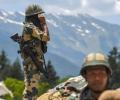
Gen Naravane said India is dealing with China in a "firm" and "non-escalatory" manner to ensure the sanctity of its claims in eastern Ladakh, and that it was even open to initiating confidence-building measures.

The Tibetan nation still lives under the yoke of the Chinese Communist Party, and Beijing today has a guilty conscience; this creates a great uneasiness for Xi Jinping and his colleagues observes Claude Arpi.

'The US will not want to tangle with China landwards.' 'Nor will the US confront the Chinese navy seawards on India's account.'

Lt Gen PGK Menon, the commander of the Leh-based 14 Corps, popularly known as 'Fire and Fury' Corps, briefed the army chief on various aspects of the situation in eastern Ladakh.
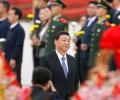
An exclusive white paper by the Jamestown Foundation claims that the powerful figures arraigned against the President include former Vice-President Zeng Qinghong and current Vice-President Wang Qishan, The Hong Kong Post reported.
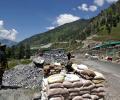
The meeting was attended by National Security Advisor Ajit Doval, Chief of Defence Staff General Bipin Rawat, Army Chief General M M Naravane, Navy Chief Admiral Karambir Singh and Indian Air Force Chief Air Chief Marshal R K S Bhadauria.

'The adversary will always exploit India's anti-national elements.'
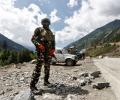
The top military brass reviewed the situation in eastern Ladakh and deliberated on key issues to be flagged at the talks on Monday, the sources said. Army Chief General M M Naravane and several top military officials were present in the meeting.

India was fooled into believing that Communist China wanted a 'negotiated' settlement with the Tibetans; it was never the case, says Claude Arpi.
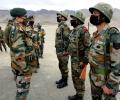
The seventh round of military talks between India and China held on Monday was "positive and constructive", and both sides agreed to earnestly implement the understanding reached by their leaders to not turn differences into disputes, a joint statement by the two armies said on Tuesday.
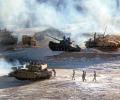
'We must be careful because China has not given its design in Eastern Ladakh.'

'While China has been hiking its defence spending, India has done precious little in implementing the Manmohan Singh government's decision of raising a 90,000-strong China-centric Mountain Strike Corps,' says Rajeev Sharma.
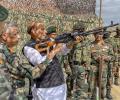
Rajnath Singh believes it would be naive to see disengagement of the armies from the LAC as the end of the trouble. The defence minister has urged the defence forces to be ready for a long haul

'We would have faced many more Galwans had Indian troops not reacted and retaliated the way they did.'

The meeting started at around 11.30 am at Moldo on the Chinese side of Line of Actual Control (LAC) opposite Chushul to defuse the tensions in Eastern Ladakh sector due to Chinese military build-up, the sources said. This is the second meeting between the two corps commanders.

'We are facing the most critical military situation with China in the last 50 years.'

Prime Minister Modi made a strategic blunder of Nehruvian proportions -- presuming no war can happen now, and the Chinese won't be a military threat and risk their economic interests, observes Shekhar Gupta.

On the first anniversary of the deadly clashes, the army said the supreme sacrifice of the soldiers while fighting the adversary in the "most difficult" high altitude terrain will be "eternally etched" in the memory of the nation.
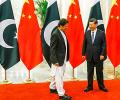
'If a 'two-front war' develops, Iron Brother may only turn out to be a drag on the PLA, since Pakistan is in no position to wage a war with India,' argues Ambassador M K Bhadrakumar.
'I am ashamed we are dealing with such adversaries.'
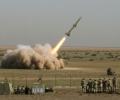
China has flight tested an upgraded version of its 10,000-km range Dongfeng missile which can reach most of the US and European cities, demonstrating its nuclear capability, media reports said.

China's newly-formed Rocket Force has held an exercise with advanced DF-16 medium-range ballistic missile with a range of over 1,000 kms that could threaten a number countries, including India, Japan and the United States.
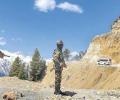
The meeting primarily focused on implementation of certain decisions taken at the fifth round of talks between Corps Commanders of the two armies last week on the disengagement process as well as to bring down prevailing tension in the region, sources said.

The two sides are also expected to finalise a roadmap for restoration of peace and tranquility in the high-altitude region that witnessed an eight-week bitter standoff between the troops of the two countries.

'There are major implications for India. Though there was a transparently thin attempt to project the troop reduction as intended to promote peace, the downsizing is actually part of plans to streamline and strengthen the PLA, capable of defending China's national interests at home and abroad,' says Jayadev Ranade.
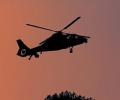
A suspicious low-altitude drone flying in the restricted airspace of the Chinese capital that sparked a major security alert and delayed a number of commercial flights, was shot down by the People's Liberation Army military helicopter, state-media reported one year after the incident.

'When we want to, we will be able to breach it, go across and strike when we need. This was the message we wanted to convey and we did'

Lieutenant General Wei Fenghe's, China's new defence minister's, first guest of honour could be his Indian counterpart Nirmala Sitharaman.
The high-level talks came a week after 20 Indian Army personnel were killed in a violent clash between the two sides in Galwan Valley.

It will be interesting to see whether India-China border tensions figure during the deliberations of PLA deputies to the NPC and CPPCC, notes Jayadeva Ranade, the distinguished China expert and retired RA&W officer.

'If you behave like a nail, the adversary will behave like a hammer.'

With the expected launch of The People's Liberation Army (Navy)'s second aircraft carrier on April 23, China will match India in carrier numbers.
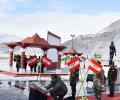
The Chinese authorities have been rapidly building defence infrastructure along the Line of Actual Control, indicating that they are preparing for a long period of tension with India, points out Jayadeva Ranade, the former senior RA&W officer and China expert.

Two elderly Chinese aerospace experts are hospitalised after a violent attack by a 'Princeling', states Jayadeva Ranade, the distinguished China expert and retired RA&W officer, highlighting the power the 'Princelings' ironically hold in the Communist People's Republic.

Why is China's supreme leader promoting Han Chauvinism so aggressively, asks Claude Arpi.

Chinese President Xi Jinping has underlined the need for building a combat-ready army and accelerate the building of the theatre joint combat command system, amidst the People's Liberation Army flexing its muscles in the disputed South China Sea.
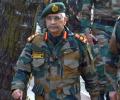
On the first day of his two-day visit to Ladakh, Gen Naravane held a series of meetings with top commanders about the evolving situation in the region as well as on India's overall combat readiness to deal with any eventualities, military sources said.

India cannot choose its geography and devise regional strategies to dovetail into the Western Indian Ocean hypothesis conceived in the Pentagon, argues Ambassador M K Bhadrakumar.

In the early part of the Kargil operations, the army opted to more or less go it alone, sacrificing large numbers of men and officers in almost superhuman struggles against an enemy on higher ground. Some generals seem to think their predecessors would have succeeded better if they had had air resources at their disposal, points out David Devadas.
